Domain Network Analysis (DNA) Service for Colleges and Departments

This service is available to heads of colleges, departments, and institutes at NTU.

Using the institutional or address search functions of major citation databases, such as the Web of Science (WoS) and Scopus, the Library retrieves, downloads, and analyzes publications affiliated with the applying unit.

The scope of analysis is tailored to each unit’s needs. The average turnaround time is approximately four weeks. The delivery date will be arranged based on the application queue and current workload.

The key application areas and major analyses are presented below:

Application Area 1 – Research Performance Analysis

The analysis helps academic units quickly understand their own research performance as well as global developments in related fields. It serves as a reference for assessing current academic standing, exploring emerging research trends, and identifying opportunities for international collaboration. Major analyses include:

  • Publication Statistics: publication output and trends over time, publication patterns across journals, and citation impact.
  • Research Topic and Field Analysis: keyword co-occurrence analysis (Figure 1), research field distribution, and related analyses.
  • Collaboration Analysis: co-authorship networks among authors, institutions, and countries.
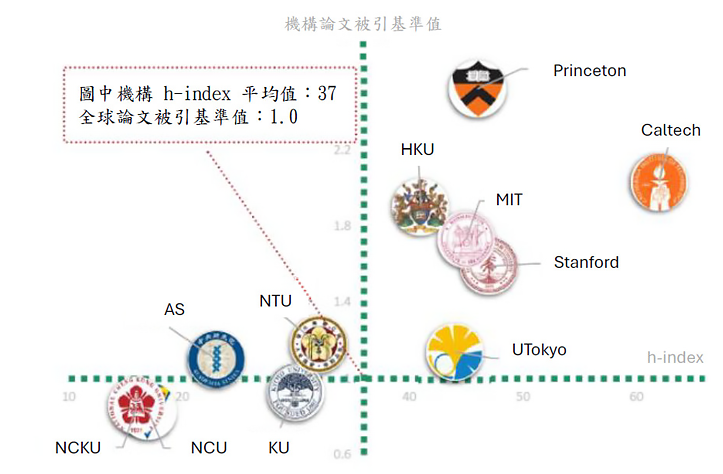
  • Benchmarking Analysis: comparative assessment of overall research performance across institutions, including publication output and citation impact (Figure 2).
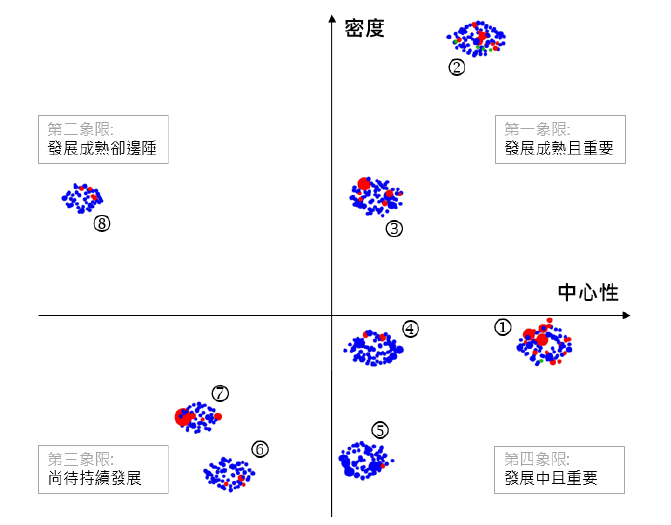
  • Strategic Diagram: analysis of the relative maturity and importance of keyword-based thematic clusters (Figure 3).

Figure 1 – College Author Keyword Co-occurrence Analysis

The figure presents an analysis of author keywords from all publications of a college. Based on their co-occurrence frequency, the keywords are grouped into color-coded clusters, providing an overview of the distribution of the college’s research topics.

Figure 2 – Citation Impact Analysis in Selected Research Areas: Comparison with International Benchmark Institutions (Source: WoS + Incites)

This analysis examines the citation impact of publications in a selected research area for a department and international benchmark institutions. Comparisons with benchmark institutions help the department assess its own research performance. (The applicant unit is required to provide a list of benchmark institutions.)

Figure 3 — Strategic Diagram for Research Decision Support

By integrating author keywords from the department’s publications (2015–2019) with global high-impact literature in related fields, this analysis examines keyword distribution and thematic overlaps. The strategic diagram visualizes the maturity and centrality of each thematic cluster, helping the department grasp its research landscape and serving as a reference for future academic development planning.

Application Area 2 – Supporting Academic Evaluation

This service helps academic units quickly assess their current research per-formance and highlight their academic strengths. Major analyses include:

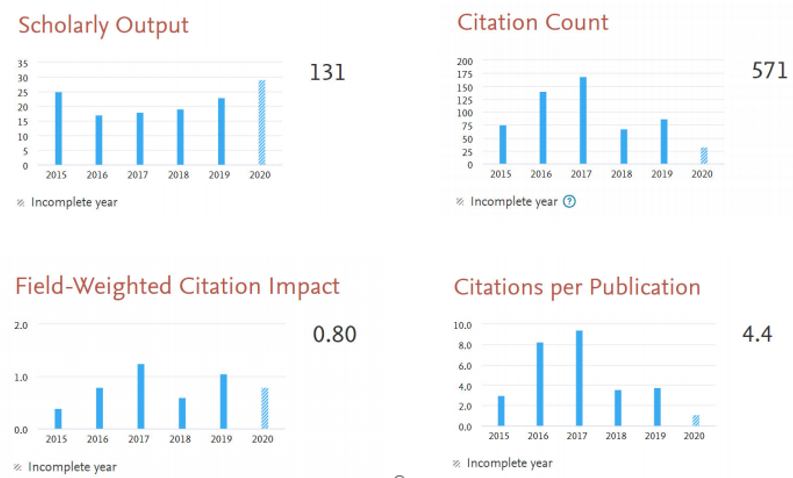
  • Research Performance Metrics: publication count, citations per publication, citation impact, and journal quality, as illustrated in Figure 4.
  • Research Field Distribution: Performance in Core Research Topics.
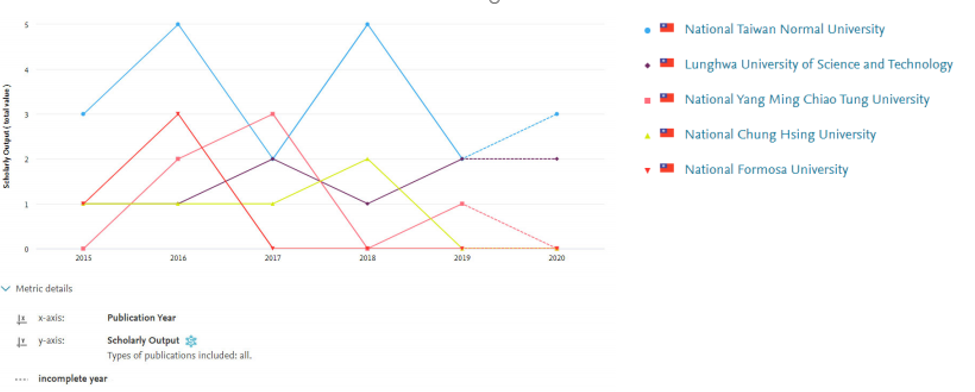
  • Collaboration Analysis: domestic and international collaboration patterns, as illustrated in Figure 5.

Figure 4 — Research Performance Metrics (Source: Scopus + SciVal)

This analysis presents the research impact for a department from 2015 to 2020, displaying annual trends in scholarly output, citation count, Field-Weighted Citation Impact (FWCI), and citations per publication. It enables the department to examine changes over time in the impact and performance of its scholarly output.

Figure 5 — Institutional Collaboration Patterns (Source: Scopus + SciVal)

This figure displays publication trends from 2015 to 2020 for a department's top five domestic collaborating institutions.

Additional Information

  • The report will provide detailed documentation of the data sources, analytical tools, methodologies, and specific analysis items used; please note that librarians do not provide disciplinary-specific qualitative interpretations of the results.
  • If the analysis service or report prove beneficial to your work, we kindly request that the librarians’ contributions be cited or acknowledged in your publications, project reports, conference presentations, or other scholarly work.
  • We may request the applicant's consent to display select portions of the analysis report as demonstration samples for this service.

Tools

The service utilizes the following tools for domain network analysis:

  • Citation Databases: Web of Science (WoS) Core Collection and Scopus. (subject to the University's current subscriptions)
  • Research Analytics Platforms: InCites and SciVal. (subject to the University's current subscriptions)
  • VOSviewer: Freeware for bibliometrics and social network analysis.
  • Gephi: Freeware for social network analysis.
  • Tableau Public: Free version of Tableau for data visualization.
  • NTU Scholars: NTU's faculty profile and research outputs platform.

Notes

This analysis service is an interactive process. During the process, applicant units may be asked to provide domain-relevant information, such as a list of benchmark universities or departments, or to help confirm terms such as synonyms.

The estimated turnaround time does not include the time spent waiting for a response from the applicant unit. If a response is delayed for an extended period, the request will be rescheduled based on the current workload once a reply is received, so as not to affect other applications.

Apply Online