This service is available to NTU full-time faculty members. In general, each faculty member may submit one application per year.
Based on information provided by the faculty member, such as keywords and publication years,the Library searches major citation databases, including Web of Science and Scopus, to identify and define a publication set that matches the faculty member's needs and is suitable for analysis.
The scope of analysis is tailored to each faculty member's needs. On average, each analysis takes approximately two weeks to complete. The delivery date will be arranged based on the application queue and current workload.
The key application areas and types of analysis are presented below.
This service helps faculty members review the current landscape of their research field, gain insights into research frontiers, and identify potential collaborators. Major analyses include:
Using CRISPR gene-editing technology as an example, the figure shows how subsequent research has expanded into diverse application areas, including in vivo applications, acute myeloid leukemia, colon cancer, colorectal cancer, breast cancer, and hair follicle development.

To support grant and award applications, faculty members may need evidence of their academic performance or prominence in a research field. Major analyses include:
Librarians will evaluate different analytical approaches and select the one that best represents the faculty member's research performance in the field.
The chart illustrates one faculty member's annual publication output and citation impact in a particular research field. In this example, both publication output and citation impact increased substantially in 2020. The linear trend also indicates an overall increase in citation impact over time.
* Source: Web of Science and InCites
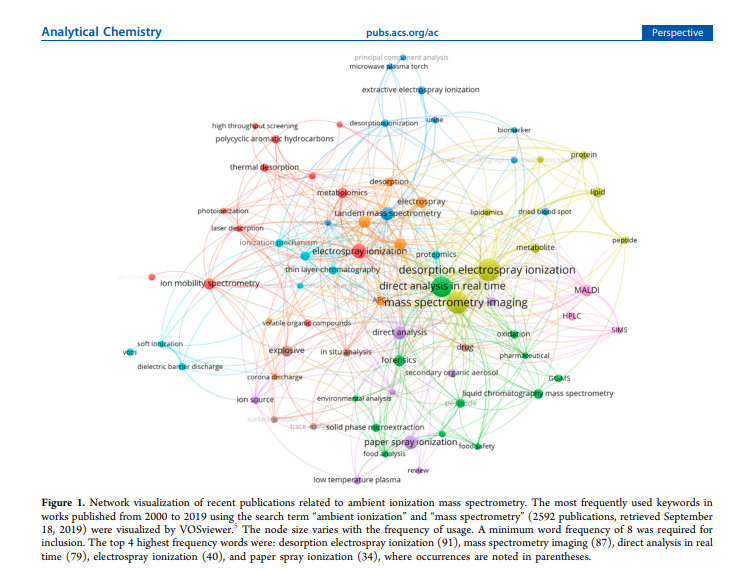
Using the keyword co-occurrence map of a research field as an example, this type of visualization helps faculty members quickly gain an overview of key research themes and development trends, and can also be incorporated directly into scholarly publications.
In one example, a faculty member used a keyword co-occurrence map generated with the assistance of the NTU Library to provide an overview of keyword co-occurrence patterns and the most frequently occurring keywords in the field of ambient ionization mass spectrometry (AIMS). The map was subsequently incorporated into the faculty member's publication, Ambient Ionization Mass Spectrometry Today and Tomorrow: Embracing Challenges and Opportunities.
* https://doi.org/10.1021/acs.analchem.9b05454
The service utilizes the following tools for domain network analysis:
This analysis service is an interactive process. During the analysis, applicants may be asked to help clarify their requirements (e.g., refining search keywords), provide information about their research field, or confirm search terms (such as synonyms) and data visualization preferences.
The estimated turnaround time does not include the time spent waiting for the applicant's response. If an applicant does not respond for an extended period, the analysis may be rescheduled after the response is received to avoid affecting the processing of other applications.
Apply Online